The Hoox MCP:
Hoox inside Claude
Connect Claude Desktop to Hoox in just a few minutes. Generate dozens of UGC videos in natural language — without writing a single line of code.
What exactly is
the Hoox MCP?
You have learned how to use Hoox manually. You understand avatars, scripts, and exports. Now imagine being able to give Claude instructions in natural language, and Claude handling everything inside Hoox for you — creating avatars, generating scripts, launching videos, exporting them — in sequence, across dozens of items at once.
That is exactly what the Hoox MCP (Model Context Protocol) enables. A direct bridge between Claude Desktop and the Hoox platform.
🤔 What exactly is MCP?
The Model Context Protocol is an open standard created by Anthropic. It allows Claude to connect to external tools — APIs, databases, software — and operate them directly from a conversation.
In practice, instead of calling the Hoox API with code, you talk to Claude. Claude understands what you want, selects the right tools, calls them in the right order, and keeps you informed at every step.
Natural language
No code. You describe what you want in plain language, Claude handles the rest. "Create 10 avatars and generate one video per avatar."
Looped execution
Claude can chain dozens of operations automatically — create avatars, then videos, then exports — without manual intervention.
Contextual intelligence
Claude understands your brief, adapts scripts to your persona, chooses the right parameters — it does not just click, it thinks.
Tool orchestration
Claude can combine Hoox tools with other MCPs — Google Drive, Notion, Slack — for even more powerful workflows.
Prerequisites avant
d'installer
Two conditions are required to use the Hoox MCP. Check both before moving on to installation.
Claude Desktop
The Claude desktop app (Mac or PC). The MCP does not work in the web browser.
⚠️ RequiredHoox Enterprise account
API access (and therefore MCP access) is reserved for Enterprise plans. Check that your plan is enabled in Settings → API.
⚠️ Required🔑 Generate your Hoox API key
Whatever platform you use (Mac or PC), you will need a Hoox API key. Generate it now:
Go to the Hoox dashboard
Sign in at app.hoox.video/dashboard with your Enterprise account.
Open your workspace settings
Click your workspace settings, then in the side menu select API.
Generate and copy your key
Click "Generate API Key", give it a name, then copy the key immediately. It will only be shown once — keep it in a safe place.
Installation
on Mac
Installation on Mac takes 3 steps. Expect about 5 to 10 minutes the first time — especially if you have never used Terminal.
Step 1 — Install Homebrew and uv
Open Terminal (search for "Terminal" in Spotlight with ⌘ + Space) and run this command to install Homebrew:
Once Homebrew is installed, it will display 3 command lines to copy, paste, and run (starting with echo >>). Run them, then execute:
Step 2 — Hoox API key
You should already have generated your key in the previous section. Keep it ready for the next step.
Step 3 — Configure Claude Desktop
Open Claude settings
In Claude Desktop: Settings → Developer → Local MCP servers
Click "Edit config". This opens Finder to a file named claude_desktop_config.json.
Open the file with a text editor
Right-click the file → Open with → TextEdit (or any other text editor).
Paste the MCP configuration
Replace the file content with the JSON below, replacing hx_live_your_key_here with your real Hoox API key:
Installation
on PC (Windows)
On Windows, installation is even simpler — a single command is enough to prepare the environment.
Step 1 — Install uv via PowerShell
Ouvre PowerShell (search for "PowerShell" in the Start menu) and run this command:
Set-ExecutionPolicy RemoteSigned -Scope CurrentUser in PowerShell and confirm, then run the installation command again.
Step 2 — Hoox API key
Same process as on Mac: generate your key from app.hoox.video → Settings → API.
Step 3 — Configure Claude Desktop
Open Claude settings
In Claude Desktop: Settings → Developer → Local MCP servers
Click "Edit config". File Explorer opens the file claude_desktop_config.json.
Open the file with Notepad
Right-click the file → Open with → Notepad (or Notepad++, VS Code if you have them).
Paste the MCP configuration
Replace the content with the same JSON as on Mac. Do not forget to replace hx_live_your_key_here with your real key:
hx_live_.
Available
tools
Once the MCP is connected, Claude has access to 13 Hoox tools that it can call on request or autonomously. You do not need to memorize them — Claude knows which one to use based on what you ask for.
| Tool | What it does | Usage typique |
|---|---|---|
| list_avatars | Lists all avatars available on your account | "Show me my avatars" |
| list_voices | Lists all available voices | "Which female voices are available in French?" |
| create_avatar | Creates a new avatar from an image or a product URL | "Create 10 avatars with this product" |
| get_avatar | Retrieves information about a specific avatar | Checks details before generation |
| get_avatar_look | Retrieves an avatar’s look variants | Selects a specific look for the video |
| get_avatar_status | Checks whether an avatar is ready to use | Wait step between creation and use |
| edit_avatar | Modifies the look of an existing avatar | "Change this avatar’s outfit" |
| generate_script | Generates a UGC script from a prompt or a product URL | "Write 25 scripts for this product" |
| start_generation | Launches video generation | Produces the video with avatar + voice + script |
| get_generation_status | Monitors the progress of a generation in progress | Claude automatically waits for completion |
| start_export | Starts the MP4 export of a generated video | Retrieves the download link |
| get_export_status | Checks whether the export is complete | Monitors processing before delivery |
| duplicate_video | Duplicates an existing video to modify it | Creates variations of the same content |
💡 Exemples de prompts efficaces
Paste your product page URL directly into the prompt — Claude will scrape the information, generate the scripts, and create the videos:
"Generate 5 UGC videos for this product: [URL]. American tone, 30 seconds, vertical format. Export with Veo 3 Fast."
Claude can generate the same concept in multiple languages with different avatars:
"Take this script and generate a French, English, and Spanish version. Use a different avatar for each language. Export all 3."
To optimize ad performance, ask for variations of the opening hook:
"Generate 10 variants of the same script, changing only the first 5 seconds (the hook). Same avatar, same voice. I want to test what performs best."
You can paste a list of prompts or URLs directly into the chat:
"Here are 20 different scripts. Generate one video for each, alternating across my 4 avatars. Vertical format, Veo 3 Fast. Tell me when it is done."
Real use case :
25 videos from one instruction
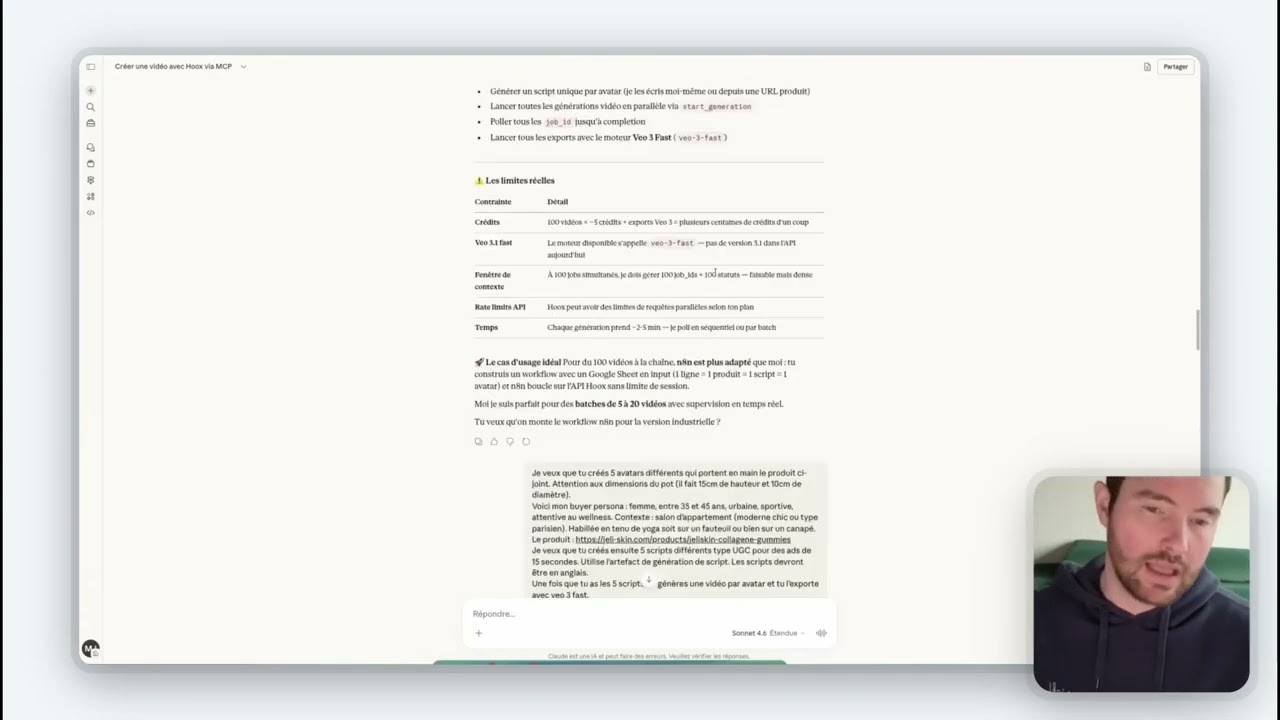
Here is a real example: a complete production of 25 UGC videos for the brand Jeliskin, launched with a single prompt. Claude handled everything autonomously.
📋 The prompt used
Here is the exact prompt that launched the full production:
I want you to create 25 different avatars holding the attached product in their hand.
Pay attention to the jar dimensions (it is 15 cm tall and 10 cm in diameter).
Voici mon buyer persona : female, between 35 and 45 years old, urban, athletic, wellness-conscious. Context: apartment living room (modern chic or Parisian style). Wearing yoga clothing, either seated on an armchair or on a sofa.
The product: https://jeli-skin.com/products/jeliskin-collagene-gummies
I want you to create ensuite 25 different scripts UGC-style scripts for ads for 15 secondes. Use the script generation artifact. The scripts must be in English.
Once you have the 25 scripts, generate one video per avatar and export it with Veo 3 Fast.
En gros : 1 script en English = 1 avatar = 1 export avec Veo 3.
Dis moi si tu as tout bien compris ?
🤖 What Claude does automatically
Analyze the brief and scrape the product page
Claude visits the Jeliskin URL, extracts product information (name, benefits, images), and builds the generation context.
Create the 25 avatars in sequence
Claude appelle create_avatar 25 times, varying the looks according to the buyer persona (yoga outfit, Parisian living room, product in hand). It waits for confirmation of each avatar before moving to the next.
Generate the 25 scripts
Claude crée 25 scripts UGC distincts en English (hooks différents, angles de persuasion variés, 15 secondes chacun) en s'appuyant sur les infos produit.
Launch the 25 videos and export them
For each avatar/script pair, Claude calls start_generation, monitors status with get_generation_status, puis lance start_export en Veo 3 Fast. Il recommence jusqu'au 25e.
🧩 Keys to a strong prompt
Precise buyer persona
Age, lifestyle, visual context, outfit — the more precise you are, the more aligned the avatars will be with your target audience.
Physical product constraints
The jar dimensions allow Claude to calibrate the proportions between the avatar and the product held in hand.
Direct product URL
Claude scrapes the page to automatically enrich the scripts — benefits, ingredients, and brand claims.
Ask for confirmation
"Tell me if you understood everything correctly" is a good practice — Claude restates the plan before executing, which helps avoid errors.
Quiz &
Exercise
Validate your knowledge of the Hoox MCP before starting your first automated production.
🧠 Quiz — MCP Hoox
0 / 501Which Hoox plan is required to use the MCP?
02Which file should you paste the MCP JSON configuration into?
03What is the first command to run on Mac to install the MCP?
04What is the main difference between the MCP and the classic Hoox API?
05In the Jeliskin case, why does Claude ask for confirmation before starting?
Your first MCP production
Follow these steps to complete your first automated production with the Hoox MCP. Check each step off as you go.
- Install the MCP according to your OS (Mac or PC) — make sure the Hoox icon appears in Claude Desktop
- Test the connection by asking Claude: "List my available avatars on Hoox" — it should reply with your real avatars
- Choose a product you want to promote (existing product page or fictional product) and define your buyer persona in 3–4 lines
- Write your prompt specifying: number of videos, duration, script language, format (vertical), export model (for example: Veo 3 Fast)
- Ask for confirmation from Claude before it starts — let it restate the plan and correct it if needed
- Launch production and watch Claude chain the tools automatically
- Retrieve the export links and download your videos — then analyze what worked well in your prompt
Ready to produce
differently?
Let’s take 30 minutes to frame the offer that best fits your goals.